
March 10, 2026
Fluvius Access Power: What’s the Difference from Peak Power, and How Do You Set It Up Wisely?

Published by
Olivier Maurissen
Covolt Belgium
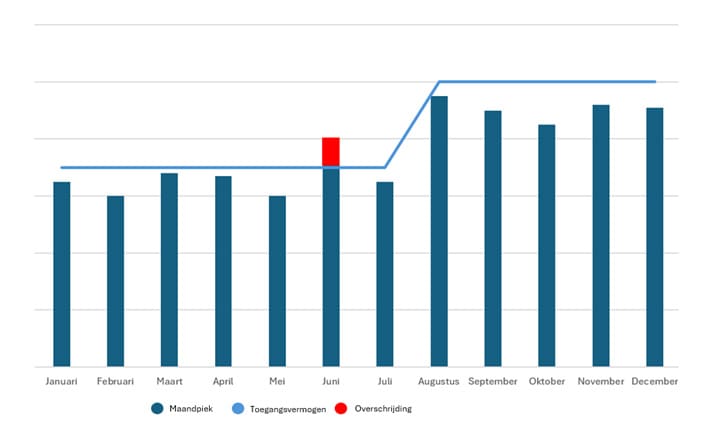
Anyone who exceeds their connection capacity will pay up to 50% more in grid fees. Not just once, but for the next 12 months! That can add up quickly. Covolt’s Power Control
monitors this, so you won’t face any unexpected surprises.
The input power is sometimes overlooked in practice. This is certainly not unimportant. Discharging an inverter at full power while the input power has not (yet) been adjusted? You will pay for the next 12 months.
This knowledge is not self-evident either. With this blog, we give you clear insight into how access rights work and how you can set them up.
Capacity tariff, access capacity, monthly peak, and physical capacity—what is the difference?
Capacity charge:The capacity charge is the way Fluvius calculates grid costs based on power (kW) rather than just energy (kWh). This means you pay not only for how much electricity you consume, but also—and more importantly—for the load you place on the power grid during peak times.
For companies with high-volume metering, this means that grid costs depend on:
- The capacity you reserve (access power)
- The effective consumption peaks you cause (monthly peak)
Power Capacity:With this option, you reserve a specific amount of power (kW) in advance. This becomes the contractually agreed-upon maximum.
If you exceed this capacity, you will be charged an excess fee of +50%, and this excess will be reflected in your costs for 12 months.
The rules are as follows:
- Increases can be made every month
- Reductions can only be made 12 months after your last increase.
- The change always takes effect on the first day of the following month.
Correct setup is therefore crucial. Incorrect setup will haunt you for at least a year.
Monthly peak:or peak power is the highest amount of power you actually use during that specific month. The highest peak for that month determines your bill.
Physical capacity:Physical capacity refers to the maximum technical capacity that you can physically draw from the grid. This is determined by the grid connection. Subject to approval, this capacity can be increased. A one-time fee is charged for this when the business is first connected to the grid or when the capacity is increased.
However, please note: for more than 180 companies in Flanders, this is no longer possible due to grid congestion. (More than 180 companies in Flanders cannot connect to the electricity grid due to an overloaded power grid | VRT NWS: news). We will devote a separate blog to this topic later.
Avoid a fine? Or drive smart?
- Do not increase the access capacity
- Manage the battery intelligently so that the total peak load stays below the limit. We call that peak shaving.
With Power Control from Covolt: Control your peaks
With Power Control from Covolt:
- Do we continuously monitor your grid connection?
- We prevent you from exceeding the access capacity
- Avoid long-term overage charges
What are the requirements and conditions for setting up access capacity?
Good to know: Covolt can take care of everything for you.
Together, we analyze your historical energy consumption, look ahead to your future plans, and use our smart algorithms to determine the optimal access capacity for your situation. Not too high, not too low, but economically tailored to your business operations so that we avoid additional costs.
Find out what else we cando for you
Together with you, we determine the required combination of services that fit your specific needs and goals. Regardless of whether you are, for example, an agriculturist or a large property manager.
