
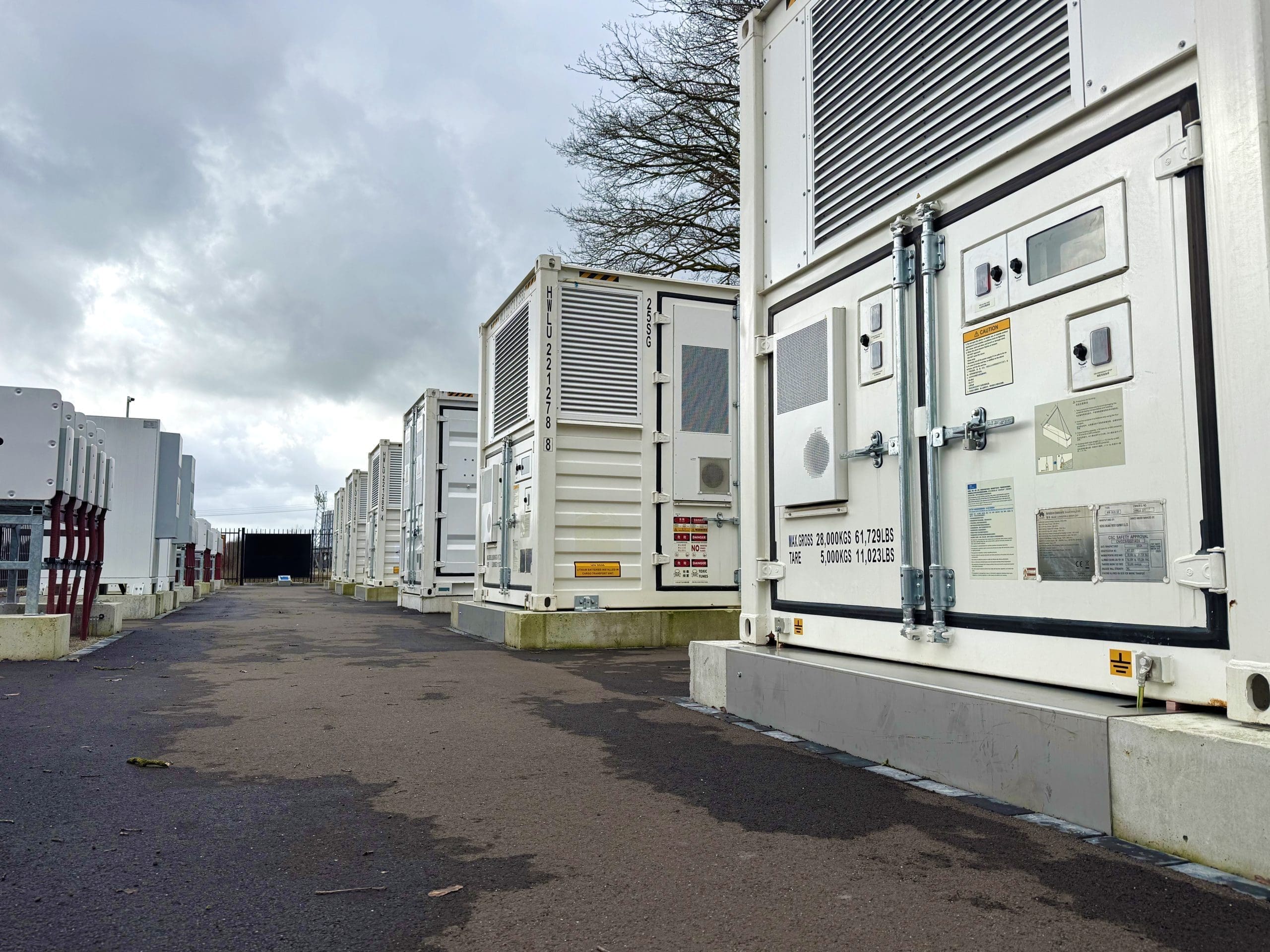
Curtailment: Optimize Your Solar System
When the supply of energy on the power grid, due to solar or wind production, among other things, exceeds demand, the grid can become overloaded. In some cases, negative prices even arise, forcing you to pay for the electricity generated. These negative prices will become more common. This is when Covolt's curtailment is a good solution.
Optimize your solar investments
The table to the right shows the number of hours with negative power prices in 2024 and early 2025.

What is curtailment?
Curtailment is the temporary reduction of electricity generation from a solar installation, usually to prevent overloading the power grid or negative energy prices. When your system is curtailed, it generates less or no electricity for a certain period—this may sound like a loss, but the financial benefit often more than compensates for the missed generation. What curtailment does is precisely balance the supply and demand for energy. And that’s where the profit lies.
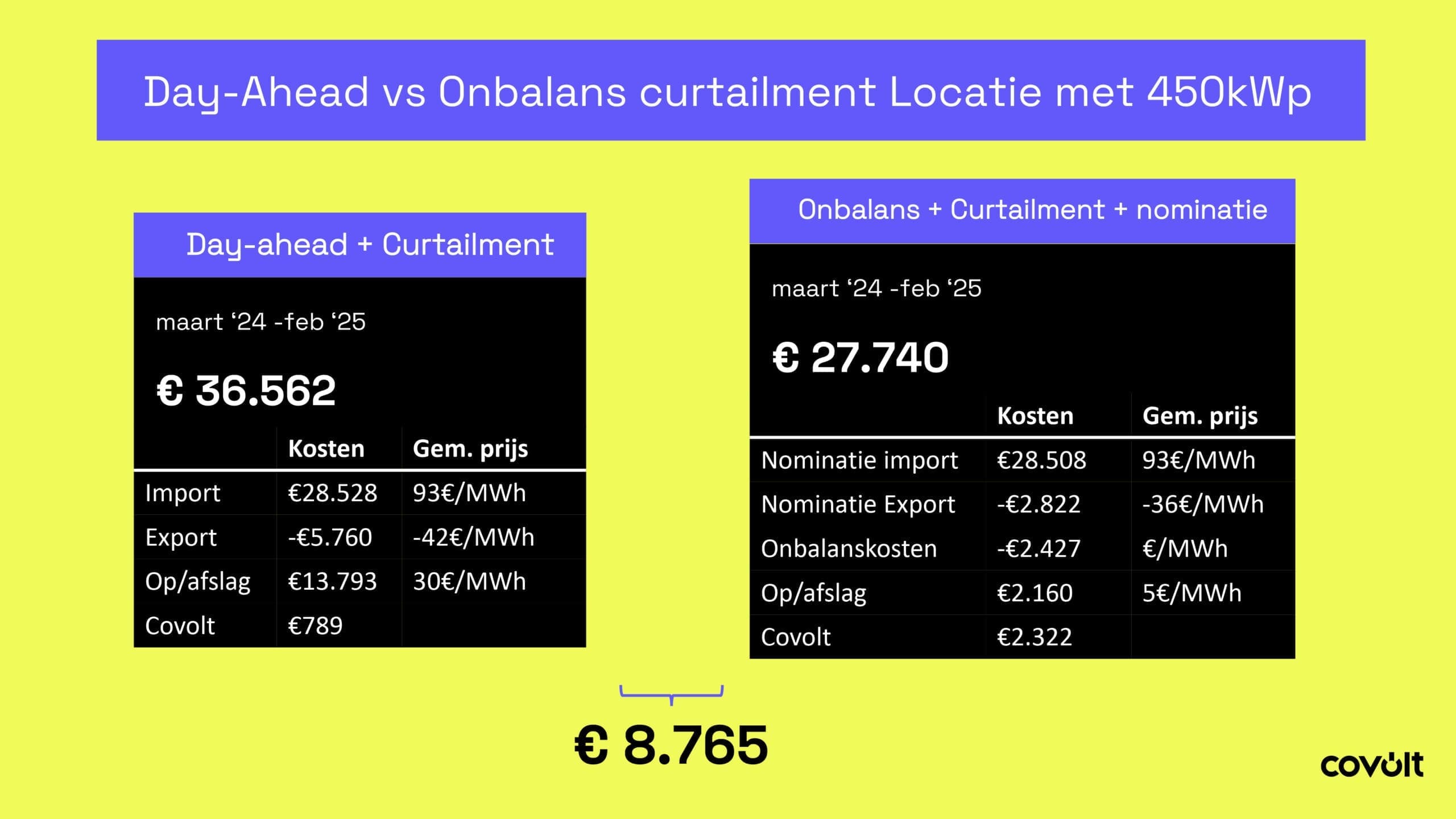
The example below shows the difference in price between a Day-Ahead contract with curtailment and an Imbalance contract with curtailment.
Explanation of calculation
(Nomination) import: The cost of the power you bring in from the grid
(Nomination) export: The cost of the power you feed back to the grid.
Imbalance costs: The cost you incur for the imbalance
Up/down: The cost you pay to the energy supplier. This includes markup and markdown and buying out the imbalance risk.
Covolt: The monthly charges to Covolt.
It is important to note that this is a calculation example and results may vary from one installation to another. To get an accurate picture of the situation for your solar panel installation, contact us.
Meaning of "curtailment"
Curtailment literally means “restriction” or “limitation.” In the energy market, it specifically refers to the deliberate reduction of a facility’s electricity generation, usually at times when the supply of energy on the grid exceeds demand. This can be either mandatory—imposed by the grid operator in the event of grid congestion—or strategic, when Covolt itself decides to reduce production because the energy price is unfavorable at that moment.
How can you prevent curtailment?
It’s usually not possible to completely prevent curtailment—and it’s often not desirable either, since it actually generates revenue for you. However, you can limit its impact:
- Add energy storage. With a battery, you can store excess solar power instead of being forced to feed it back into the grid when the grid is at capacity or the price is negative.
- Optimize self-consumption. The more electricity you use yourself at the same time you generate it, the less you depend on favorable feed-in rates.
- Smart control via an EMS. Covolt’s Energy Management System predicts market prices and proactively adjusts production so that curtailment occurs as much as possible at the most cost-effective times, rather than at random.
Please contact us to see which combination of these options is best suited for your installation.
Smart steering
Covolt controls your solar installation with a self-developed Energy Management System (EMS). Our software predicts your own consumption, the imbalance prices and takes into account your SDE subsidy and other costs. The EMS consists of smart software and a control box that we install at your location.
Benefits:
- Advanced algorithms accurately predict supply and demand
- Optimization on SDE subsidies and own consumption
- Dynamic power control within your grid connection
- Real-time monitoring via our app
- 4G connectivity with 99% uptime guarantee
- Also suitable for controlling your battery and charging stations
Get the most out of your
system with Covolt
Covolt is the only party in the Netherlands that combines Aggregator Services with Asset Management. This unique perspective ensures optimized decisions, including both income and a concern for your assets. We are completely independent and act only in your best interest - with no hidden costs. Unlike other providers, we work with a transparent flat fee, so that all additional revenues are entirely yours. We are happy to look at your situation together and show you how much extra return you can achieve with our aggregator services. Contact us today for no-obligation advice!
+31 85 401 57 50 or sales-nl@covolt.eu
When does curtailment occur?
Curtailment occurs when the supply of energy on the power grid exceeds demand, for example, due to a spike in solar or wind generation. In some cases, this results in negative energy prices, making it more financially advantageous to temporarily reduce generation.
Is curtailment mandatory or strategic?
Both situations can occur. In the case of mandatory curtailment, the grid operator temporarily limits the amount of electricity you’re allowed to feed back into the grid—for example, due to grid congestion in your region—and you’ll usually receive compensation for this. In the case of strategic curtailment, Covolt chooses to reduce production because the market price at that moment is so low or negative that producing and feeding power back into the grid would be financially disadvantageous. Read more about this distinction in our article on nomination, curtailment, and imbalance trading.
Who is responsible for curtailment—me or the grid operator?
That depends on the situation. In the case of mandatory curtailment, the grid operator imposes the restriction. In the case of strategic curtailment, Covolt determines—on your behalf and based on real-time market data—when curtailment is financially advantageous. In both cases, Covolt automatically handles the implementation via the on-site Control Box.
Will curtailment cost me production—and therefore money?
You do indeed lose some of your potential generation, but that loss is generally much smaller than the costs you would incur (or the revenue you would forgo) if you were to continue generating electricity during periods of negative prices. All things considered, curtailment yields a higher return than it costs in most cases.
